Friday, February 24, 2012

Daytrip to Warsaw

Taking the Train

It will come as no surprise to hear that the train system in Poland is excellent and comparable to the trains I've enjoyed in many other parts of Europe.  I'm proud to report that my Polish is improving, and I was able the day before my trip to visit the Poznań train station and purchase my ticket to Warsaw, with return, reserved seat, second class (which is quite pleasant) and at the times I needed, using Polish only.  There are regularly scheduled express trains that connect Warsaw and Berlin, and Poznań bisects that route, so the city benefits from its strategic location in that respect.  Consequently, the trip to Warsaw took just three hours, and the return on an even faster train took just 2 1/2 hours. 


Trains here are comfortable, clean and reliable.

The trip took me through miles of flat farmland and past or through a number of small towns.  It was a gray, snowy day, but even so, the scenery was interesting.  I have no doubt spring and summer will soon replace the bleakness of this day.

Farm fields are bleak and barren now, but will certainly
change considerably in the coming weeks and months.


My train passed quite a few farm villages.


The Meeting in Warsaw

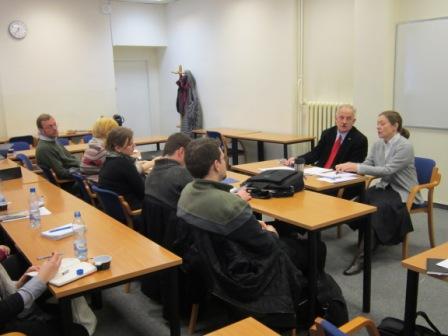
The purpose of my trip was to attend an orientation meeting for Fulbrighters in Poland, mainly those arriving for the spring semester.  A much more elaborate orientation, including visits to Polish cities such as Kraków and Wrocłow, was held in September when most Fulbrighters begin their fellowships.  Still, even this short meeting last week was useful and enjoyable, allowing me to meet some of my Fulbright colleagues here.  About a dozen attended, including faculty and students. 

Polish-U.S. Fulbright Commission members Andrzej Dakowski and
Dorota Rogowska (at head table) explain aspects of the Fulbright
program to student and faculty Fulbright grantees.
Grantees in Poland represent a wide range of focuses.  The group meeting this time included an anthropologist studying Holocaust related issues; a pianist studying Chopin, the great Polish composer; a journalism scholar; a theatrical director studying Polish directing techniques; an artist teaching painting; a geologist researching geophysics and environmental issues; and others with equally interesting backgrounds, interests and research pursuits. 

Official gatherings of this nature are never complete without a fine meal, and this gathering was no exception.  A short walk to a restaurant next to the Warsaw offices of the Fulbright Commission provided the perfect setting for an enjoyable lunch.


Faculty and student Fulbright grantees continue their
discussions over lunch.


My return train to Poznań was scheduled to depart Warsaw around 3 p.m., and this was on a Friday.  Thank goodness I had made a reservation!  The train was packed with business people and weekenders headed out of Warsaw, many to Berlin, for the weekend.  Again, though, the train departed on time and maintained its precise schedule, arriving in Poznań around 5:30 p.m.  Despite the near-blizzard conditions in Warsaw that day, it was clearly a city worth returning to frequently.  I look forward to those opportunties.

Do widzenia!

Monday, February 20, 2012

A Little Night Music

University Days

Last week, the Poznań University of Economics marked its "University Days," a celebration of its history and achievements.  I was privileged to receive invitations to a number of related events including panel discussions (in Polish, of course) and the screening of the film Zelazna Dama (or Iron Lady).  The weather continued to be somewhat disagreeable for most events, but I still very much enjoyed them.  Zelazna Dama was presented in its original English with Polish subtitles.  The event was held in a movie house just a few blocks from the university and was heavily attended -- all seats were filled.  The film was not what I expected but was certainly a great experience.  Although the significant political events of former British Prime Minister Margaret Thatcher's career were presented, they were not, in my view, the central theme of the picture.  Rather, the film was a moving love story about the relationship between Thatcher and her husband, Dennis.  I lived in Germany during the Falklands War and in England during several years of her leadership.  I was later serving at the Pentagon in Washington, D.C., when PM Thatcher visited that city.  Further, I was assigned to NATO in Belgium during the end of the Cold War and the last months of her time as prime minister.  Because of our unintended linkages with the "Zelazna Dama," my wife and I chose to recognize that connection by naming our dachshund "Maggie" when we acquired her as a puppy in Belgium in 1990.  "Maggie" proved to be a zelazna dama as well, living to be 17 1/2 years old after living in Belgium, Hawaii, Ohio and North Carolina.  Interesting that PM Thatcher continues to make appearances in our lives.

The Concert

For me, the highlight of University Days was the Thursday evening concert in the beautiful performance hall of the university's Academy of Music.  The first hour of the 2-hour event was actually a recognition ceremony for faculty members of the university.  This was a formal and impressive segment during which faculty members who had achieved significant accomplishments were called to the stage (in several categories) to be acknolwedged.  Their names were prominently displayed on the large backdrop screen and announced by the master of ceremonies.  Then, each recipient had a medal pinned in military style, and each proudly wore the medal during the remainder of the evening. 


Faculty members receiving their medals.
 The performance hall is a round, glass building of very contemporary design.  The interior is equally impressive and superbly functional.  Audience members enter from a spacious plaza into a large lobby where coats, boots, hats, etc. can be checked (remember -- the weather was somwhat unpleasant).  Then they climb stylized stairs to the entrances to the performance hall itself.

Stairs from the entrance lobby to the performance hall.


The 1-hour concert following the recognition ceremony was an eclectic mix of fine performances.  I presume all vocal and instrumental performers were associated with the Academy of Music, either as students or instructors.  It began with a 4-piece rock band that reminded me very much of the early "Stones" -- circa 1966.  Three guitars (the standard arrangement -- lead, rhythm and bass) and a drummer played three pieces, and the audience, in coats, ties and gowns, listened and applauded appreciatively.  For U.S. readers, it put me in mind of an Ed Sullivan show from that era.  The band really was quite good.

The rock band was followed by a 20-piece mostly brass ensemble.  There were French horns, trombones, trumpets, euphoniums, a tuba, two clarinets and two percussionists.  This group played what I would describe as traditional Polish polkas, but in a style I have not heard before.  Coming from the heavily Polish south side of Milwaukee, I've heard many polka bands, but the pieces are generally played heavily and meant for foot stomping, hand clapping and imprecise dancing.  The pieces this group played were performed crisply, lightly and cleanly.  They took on the character of fine symphonic music.  Two singers (by my estimation classically trained, a mezzo and a baritone) sang several of six or seven numbers along with the ensemble.  All musicians in this group were formally attired.  I have never heard polkas performed in this manner, and it was pure delight.  Perhaps as a former French hornist and member of numerous bands and orchestras over the years I'm biased toward this style of music.  Nevertheless, I sincerely hope I will have many more opportunities to enjoy this group in the months ahead.


The brass (plus clarinets) ensemble with two vocalists.
The third element of the performance was a wonderful soprano who sang several operatic pieces as well as "I Could Have Danced All Night" from the musical My Fair Lady.  That last piece figures heavily in the film Zelazna Dama, so it tied in other University Days events nicely.  It was certainly a new experience for me to have such a variety of musical styles combined in a single concert, but I and the rest of the audience were delighted with every aspect of the program.  In keeping with the formality and ceremonial flavor of the evening, abundant flowers were presented to performers to conclude the evening.  Another great experience in Poznań!


Flowers are given to the evening's performers.  I never did learn the
significance of the fake bird in the cage near the edge of the stage.


Next time -- a report on my day trip by train to Warsaw for a meeting at the offices of the Fulbright Commission.

Wednesday, February 15, 2012

Settling In

PUBLIC TRANSPORT
After two weeks, my experience here in Poznań, Poland, is beginning to approach a settled routine, though there are new discoveries and new wrinkles on old ones every day.  Having lived in three other European countries for nearly 10 years in the past, I was not concerned about life without a car here in Poznań, and I was correct in expecting no difficulties in that regard.  Public transport here, as in most European cities, is outstanding.  The city system is based on a network of trams that glide throughout the metropolitan area on rails.  Numerous bus routes connect with each other and the many tram lines.  With a good map and a little bit of planning, there is really nowhere I cannot access.   If I need to travel beyond the city and its environs, an excellent train system and comprehensive intercity bus service provide easy access.  A weekly pass for all trams and buses in the greater metropolitan area costs around $10.  Reasonably priced taxis meet any other needs.  


One of Poznan's ubiquitous and efficient trams passes the Zamek (castle).


Buses are well used.  This is my stop near my apartment complex
(the large building visible behind the approaching bus). 
This stop serves three separate bus lines offering easy access to
most parts of the city and to other bus and tram lines.


It still means I walk a good deal more than I would if I had a car, but the walking is part of the appeal.  Now that the arctic air has given way to temperatures around 30 Fahrenheit, walks of even a kilometer or more are not at all unpleasant.  For example, yesterday during my lunch hour, I walked a kilometer to a bus line that took me in about 15 minutes to the Tesco (extensive shopping center similar to a Super Walmart) on the outskirts of the city.  It was still a half kilometer walk from where I stepped off the bus to the Tesco entrance, but hardly a barrier.  There is slight problem with not having a vehicle on trips like this though.  After shopping for things I needed for my apartment, I had to walk back to the bus stop, then ride it a few stops, and finally walk a kilometer back to my apartment.  Carrying a backpack full of groceries, a shopping bag full of more groceries in one hand and two mops (wet and dry) in my other hand, while slipping through the slushy, partially melted snow, or balancing on a jostling bus, it’s hard to remember I’m a Ph.D., full professor and Fulbright scholar.  It can be humbling, which is not a bad thing. 

REMAINING ACTIVITIES THIS WEEK
The rest of this week holds a number of interesting agenda items.  This week, the Poznań University of Economics will mark its “University Days” with a number of significant events, and I have been invited to participate in several of them.  This evening (Wednesday, February 15), I will attend a special screening of Zelazna Dama (Iron Lady), the film about former British Prime Minister Margaret Thatcher and starring Meryl Streep.  PUE has a special connection with PM Thatcher, who was awarded an honorary doctorate here a number of years ago.  On Thursday evening, I’m invited to a special concert in the College of Music.  On Friday, I will travel by train to Warsaw (a 3-hour trip each way) for an orientation meeting for Fulbright scholars in Poland.  So, it’s an action-packed week. 


Across the street and in the median, another tram passes
in front of the main building of the university's
College of Music.  In this modern building, I will enjoy a special
"University Days" concert Thursday evening.


As to our research project, I’m using this week to refine elements of the plan such as the focus group protocol and the survey instrument.  Jacek and Martyna are providing valuable insights that are helping shape the project to application with Polish participants.  I’m also starting to prepare Martyna to serve as focus group moderator.


The impressive main entrance to the central building of the Poznań University of Economics.

I hope next week to begin exploring some of the many attractions Poznań has to offer such as a number of promising museums.  As the weather warms,  I also look forward to enjoying its lakes, parks and riverfront.  Thanks for reading, and do widzenia.


Friday, February 10, 2012

Images of Poznan

Settling In

This post will be short on narrative, but rather is meant to provide a few early photos of my new home from now until the end of July.  Winter arrived with vigor about the same time I did on February 1, and the envelope of Arctic air is relentless.  I've been following the forecasts on television, and it appears the temperature has not exceeded 20 degrees Fahrenheit since my arrival, lingering more in the 5-15 degree range.  Without a car, it means waiting for the bus and walking to shops and other destinations is a bit of an ordeal, but everyone is coping with it.  Yesterday, I awoke to a light coating of snow -- perhaps two inches.  It made for a beautiful setting but challenging navigation of the sidewalks and streets.

Enjoy the photos!

A park area in the median of a main throroughfare near my university.


Another view of the park in the median.
My apartment is just two busstops from the university.  I walk about one block from the apartment to the stop where I wait for the bus (buses come about 10 minutes apart, so the wait is never long).   After getting off the bus, I have a 2-block walk to my university office.

I ride the bus just two stops to the "zamek" or castle, then walk about two blocks to the university.  The nearest university building is visible past the castle; it starts with the tower topped by a pointed roof in the distance.
 Just a few blocks from the university is the Stary Browar (Old Brewery) shopping mall, an excellent spot for a hearty lunch at a good price.  It also includes an excellent grocery store and other shops where I can purchase items I need for my work and for my apartment.

Exterior of Stary Browar, a shopping mall created in a former brewery.

The mall includes a number of striking artworks.
My office is on the top floor (4th) of one of the main university buildings.  Small but comfortable and functional, it's where I spend the majority of my working hours. 

The view from my 4th floor office window.

Now that I'm settling into a routine, I've been able to turn my attention to our research project, the joint effort of a team comprising three faculty members (Dr. Jacek Trebecki here in Poznan, Dr. Jaehee Cho at UNC Charlotte and I) plus two graduate students (Martyna Dziubek in Poznan and Nick Woods in Charlotte).

The Poznan research team component, Martyna, Jacek and I, meet in my office.

Dr. Jacek Trebecki leads an undergraduate public relations class.

This weekend will be marked by routine tasks I must resign myself will be an ongoing aspect of the Fulbright experience: apartment cleaning and laundry!

Do widzenia!


Tuesday, February 7, 2012

First Days in Poznan

ARRIVAL IN POZNAN
It has been a whirlwind of activity since my arrival in Poznan last week Wednesday.  There is so much to report, but let me summarize quickly.  The 8-hour flight from Charlotte to Frankfurt was smooth and uneventful.  The 5-hour layover in Frankfurt was marred when I was struck by the flu, which lingered for about two days.  That made the 2-hour flight from Frankfurt to Poznan an uncomfortable one.   However, the reception committee at the Poznan airport, Dr. Jacek Trębecki and graduate student Martyna Dziubek, made my arrival pleasant and easy.  They sympathized with my discomfort due to the flu and got me settled quickly in my temporary flat.  The following afternoon (Thursday), I was well enough to view a number of potential permanent apartments with rental agent Błażej Dąbrowski.  It’s Błażej I wish to focus on in this post.
Błażej (pronounced “Bwah’-zhay) is worth a dedicated blog post because, in my view, he represents the entrepreneurial spirit of contemporary Poland.  A college graduate, he notes that his college business education prepared him for functional management positions in corporations, nonprofits or government agencies, but it did not imbue him with skills needed for innovative, idea-based initiatives that create or tap new and emerging markets.  Nevertheless, as a member of a new generation of Poles unrestricted by embedded habits of former times, Błażej was and is determined to immerse himself in the promises – and risks – of a market economy. 
His first foray into a venture enterprise, together with his brother, involved establishing a small shoe manufacturing and sales operation.  Their products were simple – sandals mostly.  They ran a small shop where they sold the shoes they made.  At first, Błażej reports, he was conflicted about charging customers a price for shoes that was more than the cost of manufacturing them.  He soon came to realize two things, however.  The first was that the customer was paying not only for the cost of the raw materials and the labor to make the final product, but also for the idea behind the product, the design, the management and administration of the operation, overhead costs, and even the marketing of the product.  The second realization came as Błażej observed the genuine pleasure the customers took in each purchase – they were pleased with the product and happy to pay a reasonable price for it.  This, he recognized, represented fair trade – in exchange for the cost of the shoes, customers received not only a quality product but also the comfort and satisfaction that came with the purchase.  This was a good model.  Regrettably, inexpensive imports, largely from Asian nations, soon marred Błażej’s early business success, and he needed to explore other opportunities.
Now, Błażej serves as a rental agent for clients seeking apartments in Poznan.  I found him several months ago through a Google search.  I was initially impressed by the quality of his website, especially the fact that I could view much of its content in English.  The site included extensive photo displays of available apartments along with detailed explanations of rental costs, including administrative fees, utilities and media (TV & Internet).  It also included a contact option, which I employed.  I had found several promising rental agents through my on-line search and sent inquiries to each, explaining my reason for coming to Poznan, the duration of my stay, and my basic requirements.  Though I received several responses during the following days, Błażej’s was the most positive and encouraging.  We soon established an ongoing virtual dialog that gave me a high level of confidence in his ability to quickly find suitable accommodations for my wife and me.  I was not disappointed. 
Błażej picked me up at my temporary flat on Thursday afternoon in his Seat sedan, and we began a well-planned agenda, visiting seven or eight apartments in roughly four hours, sometimes with the owner present, sometimes not.  He explained advantages and shortcomings of each in terms of location, features, etc.  He knows the city extremely well, so he could even describe the availability of nearby tram and bus lines.  All the while, he was making and receiving calls on his mobile phone, coordinating our apartment visits or fielding inquiries from other clients, both apartment owners and potential renters.   Still, Błażej’s focus was always on me, the customer.  As we visited and discussed the first several prospective apartments, he was able to narrow his understanding of my needs and wishes, which enabled him, as an astute businessman, to eliminate a few apartments he had originally considered.  All the while, he was both personable and business-like – qualities that augur well for his future success. 
In the early evening, he wisely suggested we conclude our formal apartment viewing and enjoy dinner.  We drove to the Stary Browar (“Old Brewery”) mall, a magnificent shopping and entertainment  center fashioned, as the name implies, from an old brewery (for my Milwaukee readers, think Pabst Brewery downtown); I will need to dedicate a future post to describing this wonderful feature of Poznan.  We had a modest but delicious (and excellent value) meal as Błażej told me about his professional path to his current occupation.  He quizzed me intently about how I had come to contact him and to choose him above other rental agents.  What words did I use for the Google search?  What was it specifically about his e-mail responses that engendered confidence and trust?  What made the website appealing?  He explained that there are roughly 400 rental agents in Poznan, and it was clear he was determined to be the best.  Moreover, though he is, of course, driven by the desire to earn a living, I would not describe his central motive as that of profit.  Rather, his motivation is the provision of a quality product or service that meets a genuine market need.  His principle is to adjust that product or service to suit the developing market need rather than to manipulate the client or customer into thinking there is a need where there is not one.  From this approach, Błażej recognizes, will come profit.  His business is growing slowly but steadily.  He recently added a second assistant to aid with the increased traffic his effective marketing is generating.  In that vein, he told me he is now recognizing the complexities of hiring the right staff and of training, retaining and motivating them. 
And Błażej is not resting on his current success.  He excitedly told me of his plans to expand his business to include temporary accommodations for tourists in Poznan.  He is especially focusing on the upcoming European Cup football (soccer) matches scheduled in Poznan.  He sees the potential for the thousands of fans who will come here, particularly those from Ireland, to enjoy their experience and generate a lively tourism trade in the months and years ahead.  If there are many more entrepreneurial Poles like Błażej, Poland will continue its successful transition, now well underway after more than 20 years, to a vibrant and solidly structured market economy. 
Błażej works with apartment owners Darek and Ola Krupa on my rental contract.

Oh, yes – Błażej found us a wonderful contemporary apartment, walking distance from the Stary Rynek (Old Market Square), conveniently on a bus line, and it even includes a well-appointed fitness center.  More on that in a subsequent post.  To learn more about Błażej and his rental agency, here’s his website: http://cityrentals.gratka.pl/ofirmie/.

Friday, January 20, 2012

Preparing to Leave

Seems Simple a Couple Years Out!

When I first applied for the Fulbright to Poland roughly two years ago, the concept of picking up and leaving Charlotte for six months was fairly abstract and registered as an exciting adventure.  I'm sure it will be that, but as the departure date quickly approaches (about 10 days, ready or not!), the countless, complex preparatory tasks seem to keep piling up.  Let me summarize some of the principal issues that a Fulbright applicant will need to consider.

Transportation

I'm referring here not just to getting to my Fulbright appointment site, but to all transportation-related issues.  What will I do with my two vehicles while I'm away for six months?  What flight routes are available to and from Poznan?  How will my wife and I get around while we're in Poland?  My reseaerch and brief experience in Poznan six years ago tell me we can rely on public transportation, and my wife and I very much enjoy walking, so this aspect is quite appealing. 

I include also under transportation the problem of luggage.  My airline allows just one suitcase on an international flight, and the second one will cost $70 each way.  Yet we need to bring clothing covering six months, from the depth of winter to the height of summer.  We'll need both suits and casual clothing for those seasons as well.  My solution there was to ship several boxes of clothing, shoes, books and other items in advance through a shipping service, which takes about six weeks, so thoughtful advance planning is needed.   Miraculously, there is a small company just outside Charlotte that specializes in shipping to Poland!  Shipping those boxes cost over $200, which is absorbed to some extent by the Fulbright travel allowance.  Of course, shipping boxes requires the gracious cooperation of my colleagues in Poznan who will have to receive and sign for them.

Finances

This is a critical issue.  Fortunately, technology makes this a much simpler problem to address than in years past.  Still, Fulbrighters have to think about how they will pay for things such as rent (if applicable), food, transportation, laundry, etc.  Standard credit cards are generally acceptable, of course, but often with a fee for each transaction that requires currency exchange calculations for the monthly bill.  Similarly, though ATM machines are readily available, there may be currency exchange charges or withdrawal limitations.  Be sure, too, you know which of your accounts ATM withdrawals will count against.  The Fulbright Commission in Warsaw makes it easy by wiring my monthly stipend to my U.S. bank account.  I discussed the best approach with my bank, and they provided an excellent solution.  Be sure to let your bank (and any other credit card providers you use) know where you'll be and for how long; if you fail to do so, the bank may block your credit and debit cards.

Accommodations

First, there's the issue of what to do with your own home while you're gone.  Rent it out?  Leave it vacant?  Have friends or relatives stay there?  Suspend utilities if it's left vacant?  Transfer utilities if you rent it out?  My wife and I made a bold choice, especially considering the current housing market.  We opted to put our home up for sale and use this opportunity to transition to a condo-style home (no more yard work!).  That meant a lot of dominoes had to fall and tumblers click at just the right time.  By divine providence, it has all worked out superbly.  Our home sold quickly, and we found the perfect ranch-style condo nearby, even closer to the UNC Charlotte campus than our current home.  With endless paperwork, prepping our home for sale, packing up once it sold, monitoring construction of the new condo, all while preparing for the move to Poland and the ambitious research project I'll undertake there, this is not a path I'd recommend for the easily frustrated. 

Then there's the issue of where to live in Poznan.  My host university graciously offered me a flat in Poznan and sent pictures of the apartment.  It looked comfortable and clean, but a bit small and spare for two people for six months.  My wife and I lived in Europe nearly 10 years, so we're fully aware of the variance in size between U.S. and European homes, but we also want to be able to occasionally host our new Polish friends in keeping with the Fulbright vision.  My host university understood and has agreed to provide a modest stipend instead of the flat; an additional stipend from the Fulbright Commission in Warsaw will permit us to rent a more suitable flat that will afford both comfort, appointments and the possibility for hospitality.

Medical

A Fulbright appointment requires a comprehensive medical exam for both the fellowship recipient and family members.  These must be accomplished well in advance and the physician's reports forwarded to CIES for review.  If satisfactory, CIES issues a medical clearance for each person, and these clearances become a critical part of the Fulbright portfolio.  Medical insurance is included in the Fulbright grant, and the Polish Consulate requires proof of that insurance before it will issue the required visas.  In this category, Fulbrighters need to consider bringing adequate supplies of any prescription medications or other similar items for the duration, or ensure that they may be obtained in the destination location.

Visas

And speaking of the Consulate, staying in Poland for six months dictates the need for a visa.  Obtaining the visas was a straightforward but time consuming process.  The Fulbright Handbook, provided upon award of the appointment, gave me a starting point.  Initially, I had to complete on-line visa applications for both my wife and me; that took a couple hours due to a combination of not having the necessary documents as I worked through the lengthy applications as well as a few glitches in the website.  Eventually, I was able to submit the applications electronically.  I had to follow that with a phone call to the Polish Consulate in Washington, D.C., to confirm receipt of the applications and to schedule an appointment to come to the Consulate to complete the application process.  That meant my wife and I had to drive to D.C. (about six hours each way) to present ourselves and our passports to the Consulate; this must be done in person.  We also had to show the Fulbright letter of appointment, proof of medical insurance and a few other documents.  I must say, despite the time-consuming process, the young woman at the Consulate was extremely helpful and courteous.  We had to leave our passports with the Consulate, along with funds to FedEx the passports (with visas) back to our home a couple weeks later.  It all worked.

Home University

Of course, I also had a good deal of paperwork to complete and coordinate through UNC Charlotte.  For example, I needed to process my research proposal through our Institutional Review Board, which must approve any research involving human subjects; my project will include focus groups and surveys.  That process is underway.  I also had to submit an application for leave with partial pay.  Universities may take different approaches to this financial aspect, but my university readily granted the leave (they're proud to have another Fulbrighter on the roles), with a deduction in my salary essentially equal to the amount of the Fulbright stipend.  That permits the university to hire adjunct faculty to teach my classes in my absence.  I think that's a fair arrangement.

Keeping it All Together

There are other aspects of the preparation process such as establishing contacts in the academic department I'll be attached to in Poznan (e.g., what about an office, a computer, university ID card, etc.?), and it would be easy to let all this administration become disorganized.  I prepared a 3-inch, tabbed binder early in the process and diligently sorted and filed pertinent papers regularly.  I did the same electronically with e-mails and other computer documents.  I've transferred to the laptop computer that will go with me all files that I might conceivably need in Poland (for research, guest lectures, etc.).  I've backed that all up on a portable hard drive, and I've started uploading a few document to "Dropbox."  I'm probably over-preparing, but I think that's the side to err on.  The binder will travel with me on the plane to Poznan.


Preparing and maintaining a binder consolidating
all Fulbright-related documents helped me stay on
top of all the paperwork.


Transportation, medical clearances, visa applications,
financial documents, and more all need to be
at hand and readily retrievable when needed.


If it seems a bit overwhelming, it can be, but in a peculiarly exhilarating way.  I'm very much at ease with the prospect of leaving in a few days, and my wife and I are deeply excited about spending six months in beautiful Poland.  As the departure date looms, I've receiving warm messages of welcome from my new colleagues in Poznan along with gracious offers of aid upon our arrival.  One professor this week said he and a graduate student are planning to prepare and provide meals for my first days there!  This is going to be great!

Wednesday, January 4, 2012

The Fulbright Application Process -- Patience & Persistence

THE FULBRIGHT APPLICATION PROCESS
The keys to successfully navigating the application process are patience and persistence.   You will also need to call upon colleagues to support your efforts by submitting documents endorsing and validating your credentials and the value of your potential contributions to the Fulbright mission and vision.  When I depart later this month for Poznan, it will have been roughly 2 ½ years since I began the formal process of applying for a Fulbright fellowship!  And my preparations to begin that process even preceded that time frame.   In this post, I’ll briefly describe the stages of the application process, though individual experiences will certainly differ.  Fundamentally, the process is similar for both academics and professionals, though professionals would be applying for short-term, project-focused assignments instead of longer-term, research- or teaching-based assignments.
The Contemplative Stage
Potential applicants will have a myriad of reasons for considering pursuit of a Fulbright appointment.  My reasons sprang from roughly 10 years of living and working in Europe (Germany, England, Belgium) during the 1980s and ‘90s.  It’s an environment I enjoy and in which I’m quite comfortable.  Add to that my interest in global public relations and increasing our understanding of the complexities of practicing the discipline across borders and cultures, and the Fulbright program becomes a perfect platform.  UNC Charlotte benefits from an outstanding International Program Office that promotes, encourages and facilitates education abroad for our students, welcomes and supports exchange students studying on our campus, and helps faculty and administrators pursue international experiences.  One of the IPO’s regular offerings are seminars for faculty considering the Fulbright program.  These were extremely helpful in helping me understand the purpose and vision of the program as well as the procedures for applying.  At these seminars, I was able to hear from Fulbright alumni (“Fulbrighters,” they’re called) both from my own campus and from other universities.  They were frank and informative, ensuring that potential applicants fully understood the responsibilities and challenges that accompany the honor of a Fulbright appointment.  If your campus does not conduct these seminars, check with other nearby campuses; I’m sure you’d be welcome to attend.  My wife and I discussed the possibility extensively and concluded that this was an adventure worth pursuing.  So to begin the thought process that must precede this decision, I strongly recommend meeting with representatives from your equivalent of the International Programs Office as well as with faculty and practitioners who have completed a Fulbright appointment.
Taking the First Steps
The Center for International Exchange of Scholars, which administers the Fulbright program, has significantly streamlined the application process in recent years, and the entire process can now be accomplished on line.  Your first challenge will be to identify the program for which you intend to apply and your country of choice.  You’ll also need to consider your preferred length of stay, start and end dates, whether you prefer to only conduct research or to teach or to do some of both, and other choices.  There are so many potential permutations that I could not possibly address them all.  Spend some time exploring the CIES website and talking to former Fulbrighters to help winnow your choices to your top preference (and the opportunity for which you feel your credentials are the strongest).  To find Fulbrighters you might talk with, visit the CIES directory where you can search by year, discipline, home state and other criteria.  Once you’ve done that, start marshaling your support materials.
What You’ll Need to Provide
The application package has several components.  First is the on-line application form itself, which asks for a summary of your credentials, personal profile information, and a summary of your proposed research project or teaching possibilities.  You’ll also indicate, by specific award number and description, the country and program for which you’re applying.  The on-line form will also require the names and contact information for three appropriate individuals willing to provide letters of reference and recommendation; be sure to discuss your application with your selected references in depth before submitting your application.  I provided my references with a point paper suggesting key messages to stress – messages that spoke to the qualities and skills required for my preferred award.  Your references will be contacted by CIES and asked to upload their recommendations to be incorporated into your application package.
You’ll also need to upload a more detailed description of your research proposal, a working bibliography and your Curriculum Vita.  All documents will be limited to a few pages for uploading, so you’ll need to spend considerable time crafting each document so it speaks to the award for which you’re applying.  Throughout the process, I periodically exchanged e-mails with Fulbrighters I had met, seeking their guidance to fine tune my application package. 
Another item you’ll need to provide for most awards is a letter of invitation from the university you hope to work with in the country of your Fulbright award.  It’s my impression this is an extremely critical component of your application.  Because I had participated in a conference at the Economics University of Poznan in 2005, I had made a valuable contact there, the conference host, Dr. Ryszard Ławniczak.  He was highly supportive of my Fulbright application and arranged for a letter of invitation from his university president; I believe that letter was a decisive factor in my award, and I urge applicants to secure such a letter before or soon after initiating the formal application process.
Patience and Persistence
I first submitted my Fulbright application in summer 2009.  That’s when the waiting and anticipation began.  Finally, in December 2009, I received encouraging news – that the CIES peer review panel had judged my application favorably, but that’s only the first stage of the approval process.  My application still needed to be screened by the Polish-U.S. Fulbright Commission in Warsaw.  At last, in March 2010, I received disappointing news – my application fell a bit short, and I was designated an “alternate candidate.”  Discouraging.  After the considerable effort required to plan and submit the application, and after nearly 10 months of waiting, my hope was deflated.
Then, quite unexpectedly, in September 2010 (now more than a year since I applied and six months since the disappointing news of my “alternate” status), I received an e-mail from CIES that funds had been identified and I would now receive the Fulbright appointment after all!  The problem was that my semester had already begun, and teaching assignments for the spring had already been made as well.  Accepting the short-notice appointment would have caused a bit of turmoil in my department.  I pursued the possibility of delaying my fellowship until the following year, but my CIES contact said the funds supporting the award could not carry over from one year to the next.  Nevertheless, she encouraged me to re-submit the application (the deadline was days away!).  It meant asking my references to quickly re-submit their letters and the university president in Poznan to do the same.  Thankfully, each of those supportive colleagues came through once again.
At last, in April 2011, nearly two years since my initial application, I received a formal letter from the Polish-U.S. Commission that my application was approved.  Patience and persistence, and in less than four weeks I’ll begin what I know will be a remarkable experience.