Thursday, April 12, 2012

Easter in Poland

While much of the U.S. enjoyed a mild winter and an unusually warm spring so far, Poland and much of Europe have remained chilly, and this follows a brutally frigid February.  March provided about a week of spring-like temperatures, but we've returned to a pattern characterized by overcast skies, low temperatures and stiff breezes.  Nevertheless, there are hopeful signs of emerging spring, and everyone here is most anxious to shed the winter coats and gloves.

Easter Celebrations

Easter is an extremely important period in Poland in keeping with its rich Catholic heritage and the strong tradition of faith that defines and shapes its culture.  The two central focuses at this season are church and family.  The many churches in Poznan, overwhelmingly Roman Catholic, offer multiple services/masses on Maundy Thursday, Good Friday and, of course, Easter Sunday.  Additionally, concerts of sacred music occur in many places of worship and other venues throughout the season.  On Easter Saturday, people here in Poznan and elsewhere in Poland visit their churhes, bringing baskets of items representing food they will serve at family gatherings on Sunday.  Each item in the basket -- sausage, bread, juice, eggs, and other items -- symbolizes some aspect of Jesus' death and resurrection.  Families bring these baskets to the priests to be blessed in preparation for the meal the following day. 

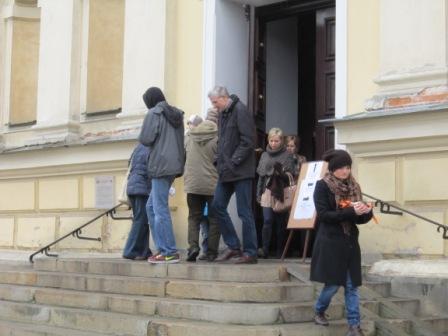
A family arrives at the local church with its basket of food
to be blessed by their priest.


After the baskets are blessed, families return home to begin
preparation of festive meals that will be shared with
extended family members on Easter Sunday.
Since our arrival here in Poznan, Robin and I have particpated actively in a very interesting English-speaking congregation that meets Sunday mornings in one of the top hotels in the city (the manager, a German, is a member of the congregation).  The Poznan International Church (http://www.international.pl/)  is sponsored by a U.S.-based mission board as well as a Polish sister congregation.  Its primary focus is the extensive population of international students who come to Poznan for its excellent medical, dental, business and other universities.  Foreign business people working in Poland also constitute a segment of the congregation.  Poles seeking a more contemporary worship service also participate.  Consequently, a Sunday morning worship service with 75 people attending will likely represent 20-25 countries.  It is truly an amazing experience, and we've made some wonderful new friends with extraordinary backgrounds through our association with the church.  For example, we have enjoyed getting to know our first acquaintance from Turkmenistan!  We all have our faith in common, so cultural and other potential barriers quickly melt away.  Even the praise band, mostly medical students, represents several countries and continents.   
On Easter Sunday, members and visitors of the Poznan
International Church gather in a hotel conference room
for worship.  Families and individuals come from a host
 of countries and represent North America, South America,
Asia and Europe.


An international praise band, primarily medical students, leads
 the congregation in song.


Our Good Friday evening service was a combined event with our sponsoring Polish congregation.  Praise songs and prayers were bi-lingual, and the Polish pastor brought the evening's message, with a young Polish student providing the English translation.  On Easter Sunday afternoon, one of the families in church -- from India -- invited the congregation to a celebratory dinner at their home.  Around 40 people accepted the gracious invitation, each bringing a tasty dish to contribute to the sumptuous table.  With so many nations represented, you can imagine the variety of dishes. 
Church members from a host of nations mingle during the
Easter gathering at the home of one of the member families.


The hosts' daughter offers appetizers to the guests.
Not only were many countries represented, but all age groups
as well!


My wife, Robin (right), preparing a salad while visiting
with our new friend from Turkmenistan.
Other Signs of Spring

Despite cool temperatures, there are indications that we will soon turn the page.  A few days have brought some relief from the chill, and people here seize those opportunities. 

Some of the city's fountains have been turned back on after
a hard winter.  This one is in the Stary Rynek.


Youngsters, eager for better weather, have returned to the
playgrounds.  Interest in soccer, always the dominant sport
here, has become even more feverish as Poznan prepares
to host early matches of Euro 2012.
Grass is beginning to green, and the trees are on the verge
of leafing out.


On one recent pleasant day, Robin and I walked to the Stary Rynek (old market square) to view the striking of noon on the tower clock.  Each day at that time here in Poznan, a bugler stands on the tower balcony and sounds a plaintiff tune.  As the clock strikes, two mechanical goats emerge from the tower and butt each other 12 times before retreating.  This day was warm enough that a small crowd gathered, and I took a short video of the event, but I have not solved the technical barriers to adding a video clip to this blog -- still working it out.  In the meantime, here's a link to a shore YouTube video of the goats: http://www.youtube.com/watch?v=ZZ0LzhsfeNI.  Incidentally, there are a fair number of nice videos of Poznan on YouTube; there's a link to one on a tab at the top of this blog.
Next week -- an update on our research project and related activities.

Do widzenia!

Thursday, April 5, 2012

Lots of Talking and a Hint of Spring

The past two weeks have been quite busy, but that's a poor excuse for the long break between posts.  Regardless, this post will bring readers up to date.  It includes an account of several recent guest lectures, provides a further glimpse of Poznań as spring offers a little tease, and reports on Robin's day trip to nearby Toruń.

Lecture Opportunities Increasing

I've spoken to several groups in the past two weeks, perhaps most significantly to a group of around 25 public relations professionals.  Enrolled in a weekend post-graduate seminar here at Poznań University of Economics, these PR professionals came from as far as Warsaw for a day-long program I prepared for Saturday, March 31.  The morning's theme was the roots of PR in the U.S.  I built the lecture around significant periods and events in U.S. history, discussing how those events and trends helped shape (and, in turn, were influenced by) the developing discipline of public relations.  For instance, for the colonial period I described events such as the Boston Tea Party and the Boston Massacre.  Next was President Andrew Jackson's hiring of Amos Kendall as essentially the first White House Press Secretary.  From there, we discussed P.T. Barnum and his "press agentry" approach to publicity, then the Robber Baron era, including the Muckrakers.  I then introduced the group to 20th Century PR icons Ed Bernays and Ivy Lee.  I spoke of the importance of the Creel Committee during World War I and the Office of War Information during World War II.  We then looked at PR's role in the expansion of U.S. economic and political influence following World War II and the emergence of the Public Relations Society of America along with its influence on increasing professionalism, including the development of ethical standards, certification, etc.  It was an effective way to acquaint Polish PR professionals with U.S. culture and history through the vehicle of our common interest in the public relations discipline.

Polish PR professionals learning about the PR contributions
of Ed Bernays.


The professionals enjoyed learning about the roots of contemporary
PR, including how the discipline became uniquily shaped by the
cultural characteristics of each country and region where it has spread.
For the afternoon session, I engaged the group in a real-world exercise.  I provided participants with background articles on the effort by the U.S. mint to introduce the dollar coin into common circulation.  I challenged the group to work in teams of 4-5 members to develop a comprehensive communication approach to persuading U.S. businesses and consumers to embrace the dollar coin instead of the dollar bill.  This is an effort the U.S. mint has repeatedly tried but at which it consistently fails.  Teams were tasked with stating the communication problem succinctly, identifying and describing target publics (demographics, motivations, values, etc.), crafting targeted message themes, selecting communication channels, suggesting strategies and tactics, and establishing evaluative metrics.  The participants dove into the challenge with energy and enthusiasm, bringing a European perspective to this problem that has vexed the U.S. Mint for decades.  Their solutions were creative and innovative and revealed a unique perspective on the issue.

Teams actively engaged in the communication
campaign exercise.


I have also presented the "Roots of PR in the U.S." lecture, divided into several sessions, for one undergraduate PR course and one graduate PR course here at Poznań University of Economics as well.  The students tell me they very much enjoy this new perspective on public relations and now more fully appreciate the role and influence of public relations in democratic societies.

On April 2, at the request of the Polish Fulbright Commission, I provided a talk to graduate students and faculty at Adam Mickeiwicz University, also here in Poznań.  Adam Mickeiwicz is one of the most prominent universities in Poland, and my remarks were part of a 2-hour seminar on Fulbright opportunities for Polish graduate students to pursue studies and research in the U.S.  My role was to offer an overview of the structure of graduate education in the U.S.  A group af around 40 participants gathered for this seminar in the the Senate Room of the Collegium Minus (main college building) of Adam Mickeiwicz.


Polish graduate students and faculty hear about the structure
of U.S. graduate education.  Officials from the Polish Fulbright
Commission in Warwaw are seated behind me.

A Hint of Spring

March teased us a bit with around 10 days of very pleasant temperatures and sunny to partly cloudy skies.  People here took full advantage, thronging to parks and walking the scenic strees of the old town.  My wife, Robin, and I walked from our apartment one Saturday to take in a pipe organ concert at a magificent church just off the Stary Rynek (old market square) in Poznań.  The setting and the music were beautiful -- a perfect Saturday noontime activity before lunch in one of the city's countless restaurants.

Fine weather in mid-March prompted people here to seize
the moment.  This is a typical outdoor cafe in Poznań's
Stary Rynek.


Just off the Stary Rynek, this beautiful church welcomed us
to an outstanding pipe organ concert on a recent Saturday noon.

Every architectural detail of the church is magnificent, and
there are numerous such churches in Poznań and
throughout Poland.


Robin's Trip to Toruń

My work demands have prevented me from traveling as I had hoped, but Robin was able to make a daytrip to nearby Toruń recently with a friend visiting from the U.S.  Many consider Toruń to be the most beautiful city in Poland; based on the photos Robin took, that's a fair statement.  The city on the Vistula River is just two hours by train from Poznań, so I very much hope I'll be able to schedule a trip soon.  I provide the photos that follow without comment except to say that they illustrate the city's beauty.


Sidelights

I just received a thank-you e-mail from someone in my hometown of Milwaukee, Wisconsin.  I had received a request several weeks ago from a friend there.  It seems her granddaughter's school (pre-school, actually) was studying Polish culture; I was asked if I would send some postcards from Poznań, and I was happy to do so, adding a few picture books and other artifacts as well.  The items met the need apparently, and the granddaughter has enjoyed acquiring a bit of the Polish language via the picture books.  The class found the items fascinating as well.  The fact that a pre-school class in Milwaukee would be studying Polish culture may seem surprising, but really is not given the strong Polish heritage in the city and the surrounding area.  In fact, the city hosts what it claims is the largest Polish festival in the U.S. every summer at the city's beautiful lakefront festival grounds.  You can learn more about the festival here: http://www.polishfest.org/.  Additionally, the city is home to the Polish Center of Wisconsin, which includes a restaurant, a library, meeting rooms, cultural events and exhibits.  Here's its link: http://polishcenterofwisconsin.org/.  I often refer to these two features of my hometown to respond to people here who wonder why I chose to apply for a Fulbright fellowship in Poland -- in many respects, it feels like home!

Research Project Status

We continue to move forward with our research project on employee communication in Poland.  We have secured our first company partner, and it's an excellent one.  Anonymity is incorprated into our research design, so I can't reveal the name of the company, but it is a major manufacturer here in Poland.  We are extremely pleased the company's leaders have welcomed this research partnership.  The other team members and I feel confident that we are very close to confirming two additional company partners in the coming days.  Our aim is to conduct our data gathering at three organizations in total, and it appears that will happen soon.

In the meantime, I continue to receive requests to speak to various classes and groups in Poland and beyond.  I take considerable delight in meeting with groups here and will make every effort to accommodate requests as my schedule allows.

Do widzenia!

Saturday, March 24, 2012

Berlin Fulbright Conference

Back to Berlin after 30 Years

It had been nearly 30 years since my last visit to Berlin before arriving there last week Sunday.  The occasion this time was a 5-day conference for Fulbright scholars in Europe.  The event is hosted by the German-U.S. Fulbright Commission, but they graciously extend the invitation to Fulbrighters serving in other European countries as well.  Needless to say, I found Berlin a very different city from the one I regularly visited on business in the early 1980s. 

As a U.S. Air Force officer assigned to the Headquarters, American Forces Network - Europe in Frankfurt a.M. from 1980-1984, I often visited our affiliate station (radio/TV) in Berlin.  I always took a day or two of leave in conjunction with the visits to explore this remarkable city.  Each visit also included a passage through Checkpoint Charlie into (then) East Berlin.  I vividly recall the bleak grayness that characterized that sector of the city, behind "The Wall."  I recall, too, walking around the barren, grim region of Alexander Platz.  As it happened, on this trip, Robin and I joined several hundred other Fulbrighters staying at the sparkling high-rise Park Inn Hotel -- in Alexander Platz!  My, how the area has changed!  Like the rest of Berlin, this area is now vibrant and colorful.  I could not stop marveling at the metamorphasis.  The vast majority of Fulbrighters participating in the conference were graduate students pursuing their studies or recent college graduates serving as English Teaching Assistants; it was sobering to realize that most were infants when the Cold War ended.  Still, they seemed to appreciate the astonishing and troubling history associated with the city of Berlin and in particular with the very area surrounding our hotel. 

The seminar featured a demanding and enriching agenda, with valuable activities from morning through late evening.  Keynote speeches, panel discussions, anecdotal reflections, discussion sessions and musical performances kept us happily busy the entire time.  Each event and logistical detail was planned and conducted perfectly by the fine staff of the German-U.S. Fulbright Commission.  Special guests included Dr. Mary Ellen Schmider, Executive Director of the Fulbright Association in Washington, D.C.; Johannes Hensel, a member of the first small cadre of German Fulbrighters who traveled to the U.S. in 1953/54 (his is a remarkable story of escaping from East Germany to West Berlin, entering university, earning a Fulbright fellowship, then serving a highly successful career with 3M in worldwide postings); and Dr. Ulrich Lippman, first Executive Director of the German-U.S. Fulbright Commission (who earned his Ph.D. at Ohio University, as did I).  We also enjoyed panel discussions featuring top German government officials on topics such as the status of European integration.

Robin and I traveled from Poznań to Berlin via PolskiBus, a fairly new service providing inexpensive and comfortable travel within Poland and to destinations near Poland.  The 4-hour bus ride was quite pleasant, despite its 4:50 a.m. departure Sunday morning.  We returned via the Berlin-Warsaw Express train, which took just 2 1/2 hours, but cost more than double the bus fare.  Getting around Berlin, of course, was easy on the U-Bahns and S-Bahns. 

I'll post more photos to my Facebook page, but following are a number of representive shots:


The comfortable coach we took from Poznań to Berlin.
Heavy fog that morning prevented us from fully
enjoying the beautiful rural scenery.


Several hundred Fulbrighters convened for the conference.
Seated in the second row, far left in the coat and tie, is
Johannes Hensel, one of the first German Fulbrighters.
In his remarks later in the conference, he cited AFN (my
former military unit in Germany) as helping him learn
English in the early 1950s.

For Sunday afternoon, conference planners arranged a menu
of cultural tours, including the one we chose to Checkpoint
Charlie and the associated museum.  Thirty years earlier, I used
to make the transit through this point into the Soviet Sector.


Only a few sections of "The Wall" remain, preserved as a
reminder of difficult times.

German-U.S. Fulbright Commission Executive Director Dr. Rolf
Hoffmann welcomes Fulbrighters to the conference.


Conference events were enthusiastically received by all
participants.

Former Fulbrighters share their experiences with
conference participants.


U.S. Fulbright Commission Executive Director Dr. Mary Ellen
Schmider addresses participants.

Among the outstanding features of the conference was a
"Music Gala" featuring Fulbrighters pursuing research or
training in vocal or instrumental performance.


An appreciative audience awards a standing ovation to
Fulbrighter performers.  They included several vocalists,
flautists, pianists and even an exceptionally gifted and
creative tuba player.

Of course, there was a little time available for sightseeing.
This is the Bode Museum, one of a seemingly endless array
of magnificent architecture from many periods.


The building that houses Germany's equivalent of the U.S.
Congress.

Naturally, we had to sample the wurst.


Breakfast in the hotel was always a great opportunity to get
to know the extraordinary young people in Berlin for the
conference and to hear about their Fulbright experiences. 

Back on the train for the return to Poznań.  A great experience
in Berlin, that's for sure, but it's good to be "home."


Thursday, March 15, 2012

Planned and Recent Fulbright Activities

This will be a wordy post, bringing readers up to date on activities (not previously reported) directly related to my Fulbright fellowship appointment here in Poznań.

Recent Activities
  • Shortly after my arrival here early last month, I was asked to prepare an article for the official magazine of the Poznań University of Economics.  The topic was not related to my work here, but rather concerned the performing arts at my home university, the University of North Carolina at Charlotte.  The magazine editors were interested in comparing the performing arts at our two universities.  It's not my academic area, but as a musician and a frequent performer in amateur productions (in four countries!) over the decades, I was happy to comply.  Using material from the UNC Charlotte website and eager assistance from officials with UNC Charlotte's College of Arts and Architecture, I was able to assemble a reasonably comprehesive article along with several great photos.  The editors are reportedly very pleased with the result, and the article should appear in this month's issue coming out in about two weeks.
  • Because of the overwhelming response to last week's initial guest lecture on preparing U.S.-style resumes, I repeated the lecture yesterday to a smaller but appreciative group of about 20 great students. 
  • I recently completed an e-mail interview for an article in my home department's e-zine.  The article will cover my impressions formed so far regarding my time in Poland.
  • Dr. Jacek Trębecki, graduate student Martyna Dziubek and I meet at least twice weekly to move our research project forward.  During recent meetings, we reviewed and polished both the focus group protocol and the survey instrument.  Team members in the U.S., Dr. Jaehee Cho and graduate student Nick Woods, have prepared both the Excel spreadsheet and the SPSS (statistical analysis software) program they will use to "crunch" the quantitative data we provide to them as a result of employee surveys we conduct here in Poland.  Dr. Trębecki, Martyna and I continue to work and negotiate with potential company partners we hope will be the subjects of our research project.
  • I'm continuing my diligent effort to acquire at least conversational skill in the Polish language.  I have two formal, hour-and-a-half classes each week, and I'm using the Rosetta Stone complete package (three parts) in Polish as well as separate books.  Having previously learned acceptable German and French plus some Spanish, I understand the process of learning a language, but Polish is still challenging.  Slavic languages introduce new layers of complexity.  It's not just because I'm old, either.  My formal class has about 10 students, none over about 25.  They're all undergraduate or graduate exchange students, and they come from Spain, Portugal, Latvia, France, Canada, Germany and Hungary.  They're having just as much of a struggle as I am.  Still, I'm making progress and use my Polish skills with increasing confidence in everyday situations.
Planned Activities
  • This Sunday (March 18), Robin and I will head to Berlin, Germany, for a 5-day seminar conducted by the German-U.S. Fulbright Commission there.  This event brings together around 200 Fulbright students and faculty members for research presentations, discussions and cultural activities.  Robin and I have not visited Berlin since my U.S. Air Force assignment to Frankfurt a.M., Germany, from 1980-'84 (30 years ago!).  My memories of Berlin include regularly passing through Checkpoint Charlie to visit (then) East Berlin.  We'll visit Checkpoint Charlie again on this trip, but it will be part of a museum!  I'm not sure I'm fully prepared for the vast changes that have occurred since my earlier visits.
  • It appears the success of my initial guest lectures is leading to a fairly regular schedule of such events here at PUE.  I expect to be meeting with PR classes once a week from now on, offering lectures and discussions on topics such as corporate social responsibility, crisis communication planning and management, PR planning, media relations, internal communications, public diplomacy, etc.  I must say this will be a most enjoyable aspect of my time here.  The students here are fully engaged in their academic journey and eagerly welcome these opportunities to explore additional vectors of our discipline.
  • On March 31, I will provide a half-day seminar to a group of about 30 PR professionals here in Poznań.  I will cover the social, political and economic contexts that have shaped (and been shaped by) the public relations profession in the last 100 years or so.  I'll also talk about emerging directions for public relations, and I'll lead the group in a real-world case analysis and planning exercise.
  • Dr. Trębecki is also arranging for me to meet with student groups at other Poznań universities -- and there are quite a few in this academically-focused city.
  • This week, I expect to be interviewed by a journalist with the Polish publication "The Business Voice" about our research project.
  • I'm coordinating with Dr. Gyorgy Szondi a visit to Budapest, Hungary, in mid-April where I hope to conduct several guest lectures and perhaps a discussion with Hungarian PR professionals.  Dr. Szondi is himself Hungarian, but he now teaches at Leeds University in Great Britain.  I met him here in Poznań at a conference in 2005 and we have remained "virtual" colleagues since then.  He contributed to a chapter in my book on global public relations.
  • On April 19, Fulbrighters in Poland will gather here in Poznań for a day-long conference.  Each of us will provide a report on our activities here in Poland; my presentation will include my research partners here and will summarize progress on our project.
  • Research team members at UNC Charlotte will present a summary of early project results during the Center for Global Public Relations conference on April 21 in Charlotte.
  • We recently received word that the panel proposal submitted by Dr. Ryszard Ławniczak here for the International PR Conference in Bled, Slovenia, in July has been accepted.  I will serve on that panel, presenting an early summary of the results of our research project here. 
I'm sure there are other events and activities I'm forgetting, but this is an adequate summary for now.  Planning and preparing for these items keeps me quite busy, and other opportunities are regularly arising.  I'll keep you posted.

Do widzenia!

Monday, March 12, 2012

Events, Week of March 5

This post provides a few details and photos on three activities from the week of March 5, 2012.

Guest Lecture

It was an honor to be asked to present a lecture for one of Dr. Jacek Trębecki's public relations classes on Wednesday afternoon.  After discussion with Dr. Trębecki and one of his top students, Katarzyna Konieckiewicz (Kasia), we settled on the unusual topic of how to prepare a U.S.-style resume as a PR student applying for internships or entry-level positions.  I was doubtful that this would be a topic of interest, but my concerns were completely misplaced.  Dr. Trębecki promoted the lecture for any students to attend, and the response was overwhelming.  Despite a large lecture hall with seating capacity for nearly 100 students, they filled the seats, and more sat on the floor or stood in any open space.  More than 150 students attended.  There would have been many more, but Dr. Trębecki, immediately recognizing the dilemma, announced that I would deliver the same lecture the following week at the same time.  That allowed students in the hall outside the room and some in the room without seats to wait for the next opportunity.

Standing room only for my lecture on preparing resumes.


It might be tempting to conclude that students here are starved for information, and that led to the large turnout, but that would be a mistake.  What this response reflects is how successful the instructors are here at motivating students to absorb all the information they possibly can.  Keep in mind, too, that I lectured in English, and yet these Polish students were able to take in and even discuss this topic thoughtfully.  I was and remain deeply impressed!

Students paid rapt attention throughout the hour and a half lecture.
Dr. Trębecki and Kasia assured me that this was a valuable session for the students.  Some may wish to apply for PR positions in the U.S. (and I can attest to the fact that they will provide stiff competition for U.S. PR students!), and some may apply with U.S. companies operating in Poland, and there are many.  Knowing how to present oneself effectively in a resume is an important skill in that regard.  Moreover, material we provided on line also addressed cover letters and job interview strategies.

Birthday Dinner

Last Friday I celebrated yet another birthday (I have no complaints, mind you!), and it was a special treat to share the occasion with some of our great Polish friends here in Poznań.  A 10-minute walk from our apartment is the beautiful Stary Rynek (old market square), with a great many inviting restaurants contributing to the festive atmosphere of the area.  We chose the Brovaria Restaurant, which features its own microbrewery.  The evening could not have been better.


The scene upon our arrival at the Stary Rynek.


The restaurant makes its own beer.  I enjoyed its "honey" brew.

Joanna Trębecki (left, front) sits across from her husband,
Jacek.  Robin and Alan Freitag are next.  To Robin's left
is Martyna Dziubek.  To Alan's right are Dr. Ryszard
Ławniczak and his wife Irene.


The birthday boy about to enjoy his roast duck,
red cabbage and dumplings.
Basketball Game

On Saturday evening, Robin and I took in a basketball game between Poznań and Warsaw in the Tauron League.  My impression is this is a semi-professional league.  A bus ride followed by a tram ride and a short walk (30 minutes total travel time) took us from our apartment to the university arena where the game was played.  We bought general admission tickets at the door for roughly $3 each.  Several hundred enthusiastic fans attended, including one with a bass drum he used regularly to generate lively cheers.  The players were impressive athletes who played with concentration and intensity. 


Just as in the U.S., the players are introduced right before
game time.  These were the hometown Poznań team members.


The tipoff marked the start of four 10-minute quarters of
constant action.

A sizable crowd rooted for the hometeam and politely
acknowledged good plays by the opponents as well.  All
players were respected for their efforts.


Action was spirited, but never was there the hint of disrespect
by any player for an opponent.  These were fine athletes
doing their best and focusing on their game.

Poznań chased Warsaw throughout the game, sometimes
trailing by as many as 10 points, but often pulling very close
and even tying the score a couple times.  In the end, though,
Warsaw prevailed, 83-81.  [Goście = Guests; Gospodarze = Hosts]


A poor photo, but I wanted to show that the game even
featured cheerleaders. 
That was another eventful week in Poznań!  There is certainly no shortage of work to be done and new activities to enjoy.  Thanks for following my blog.  Do widzenia!